Sequence mapping
A curve defines an ordered list of grid coordinates. If its \(i\)th coordinate is \((x_i,y_i)\) and the sequence is \(s\), the mapped array satisfies
This operation rearranges values. It does not interpolate between samples. Successive sequence positions occupy adjacent cells. The converse does not hold: two spatially adjacent cells can be far apart in sequence order.
A four-value example
For the standard Hilbert curve at order 1, the path is
(0,0) → (0,1) → (1,1) → (1,0).
import numpy as np
import hilbertplot as hp

values = np.array([10, 20, 30, 40])
grid = hp.data.to_grid(values, curve=0)
assert grid.tolist() == [[10, 40], [20, 30]]
recovered = hp.data.from_grid(grid, curve=0)
np.testing.assert_array_equal(recovered, values)
Coordinates are (x, y); NumPy indexing is [y, x]. Plots use origin="lower"
by default, so row zero appears at the bottom. origin="upper" changes display
orientation, not the ordering used in conversion.
Visit indices versus measurements
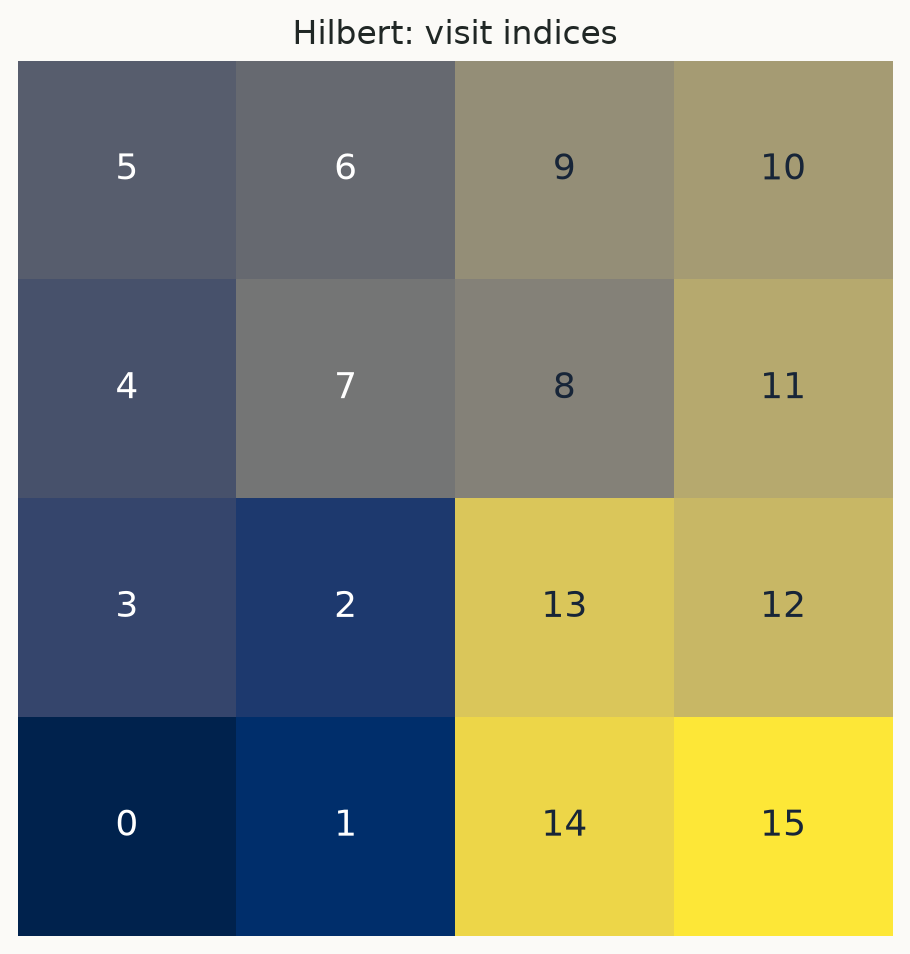
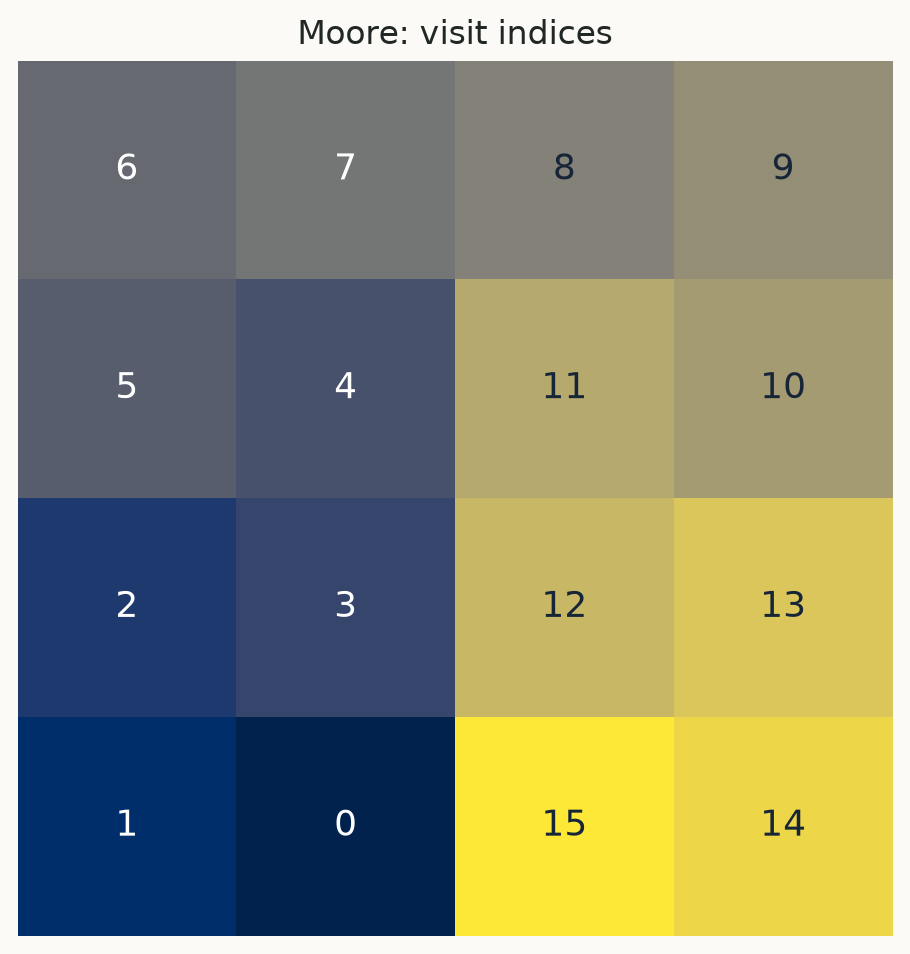
These 4 × 4 arrays contain visit indices for Hilbert and Moore at order 2.
For example, cell (0,0) has the index printed in the lower-left corner.
The index arrays differ because the curves visit the cells in different orders.
points = hp.curves.points(0, order=3)
labels = hp.curves.label_map(0, order=3)
for i, (x, y) in enumerate(points):
    assert labels[y, x] == i
Plotting a measurement sequence assigns colors to its values. The path specifies where those colors appear. Curve choice can therefore change the apparent spatial pattern without changing the input samples.
Plotting and conversion have different outputs
hp.plot() returns a Matplotlib figure and uses floating-point values for display.
hp.data.to_grid() returns the numeric array, retaining dtype and masks when no
averaging is requested. Use conversion functions for exact reconstruction, especially
for large integers, complex data, or multi-channel images.
A non-square sequence needs a fitting policy. The default pads to an enclosing power-of-two square; values are discarded only when truncation is explicitly allowed. Grid fitting defines the alternatives.