Catalog, coordinates and indexing
Catalog queries
hp.curves.info() returns a dictionary. Every selection below returns a list of those
dictionaries, in index order, ready to pass to hp.gallery().
import numpy as np
import hilbertplot as hp

info = hp.curves.info(12)
print(info["index"], info["name"], info["rule"])
all_curves = hp.curves.catalog()
proper = hp.curves.proper()                 # 6
improper = hp.curves.improper()             # 6
homogeneous = hp.curves.homogeneous()       # 12
mixed = hp.curves.inhomogeneous()           # 28
loops = hp.curves.closed()                  # 4
arbitrary = hp.curves.generalizing()        # 8
hilbert_kernels = hp.curves.by_kernels(0)    # exact kernel set
Metadata fields:
Key |
Meaning |
|---|---|
|
Stable selector from 0 through 39 |
|
Friendly label, where available |
|
Paper notation, such as |
|
|
|
One kernel type is used throughout the quadrants |
|
A construction classified as closed in the catalog |
|
Supports arbitrary squares and quasisquares |
|
Sorted list of quadrant kernel indices |
|
Kernel mix in paper notation |
|
Tag-system construction rule |
A missing memorable name is no obstacle: pass the integer index or paper symbol.
by_kernels() requires an exact set match; it does not mean “contains this kernel.”
Coordinates versus array indexing
Coordinates are (x, y): x is the column and y is the row. NumPy array access is
image[y, x]. Plots default to origin="lower", so row zero is displayed at the bottom.
For an image convention with row zero at the top, explicitly use origin="upper" when displaying.
Changing display origin does not change conversion order.
points = hp.curves.points(0, order=3)  # shape (64, 2)
assert hp.curves.is_space_filling(points, side=8)
word = hp.curves.word(0, order=3)      # 63 letters: u, d, l, r
assert len(word) == len(points) - 1
arbitrary_points = hp.curves.grid((15, 16), curve=3)
assert arbitrary_points.shape == (240, 2)
Order zero contains one cell and an empty direction word. is_space_filling() validates
squares, not quasisquares: it verifies full coverage, uniqueness, bounds and, by default,
unit-step connectivity. Pass connected=False to check coverage alone.
Labels are the inverse coordinate lookup
labels = hp.curves.label_map(0, order=3)
for index, (x, y) in enumerate(points):
    assert labels[y, x] == index
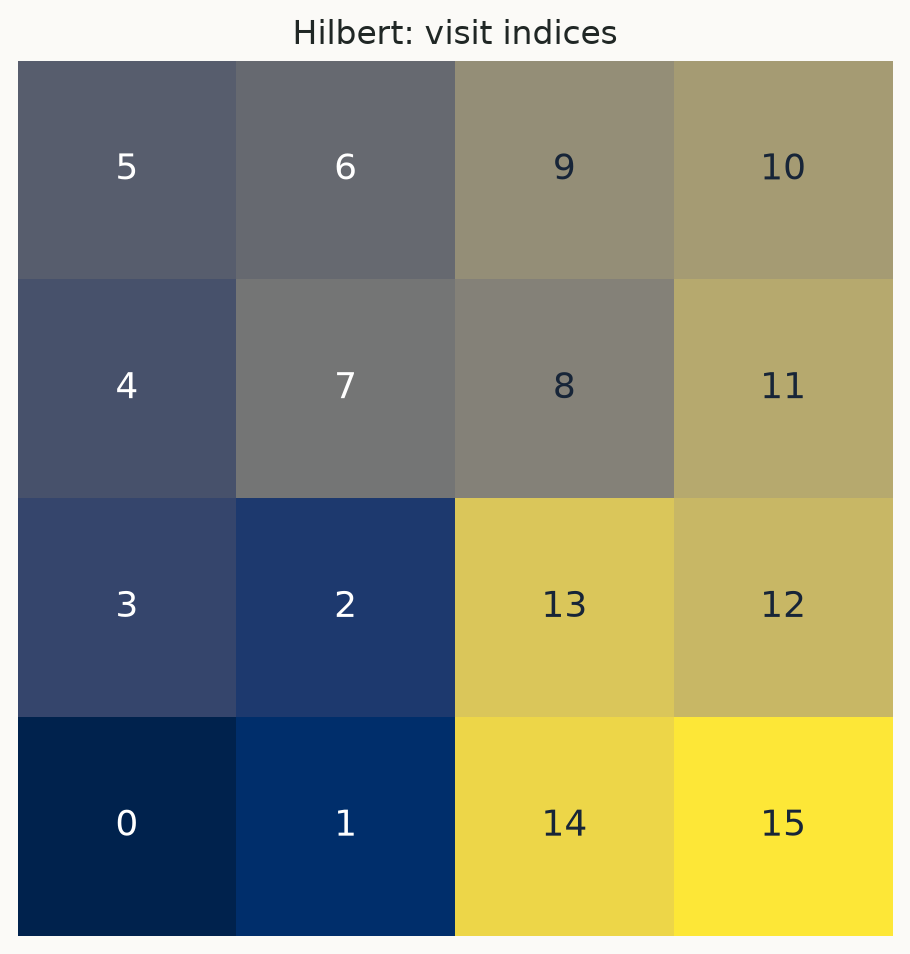
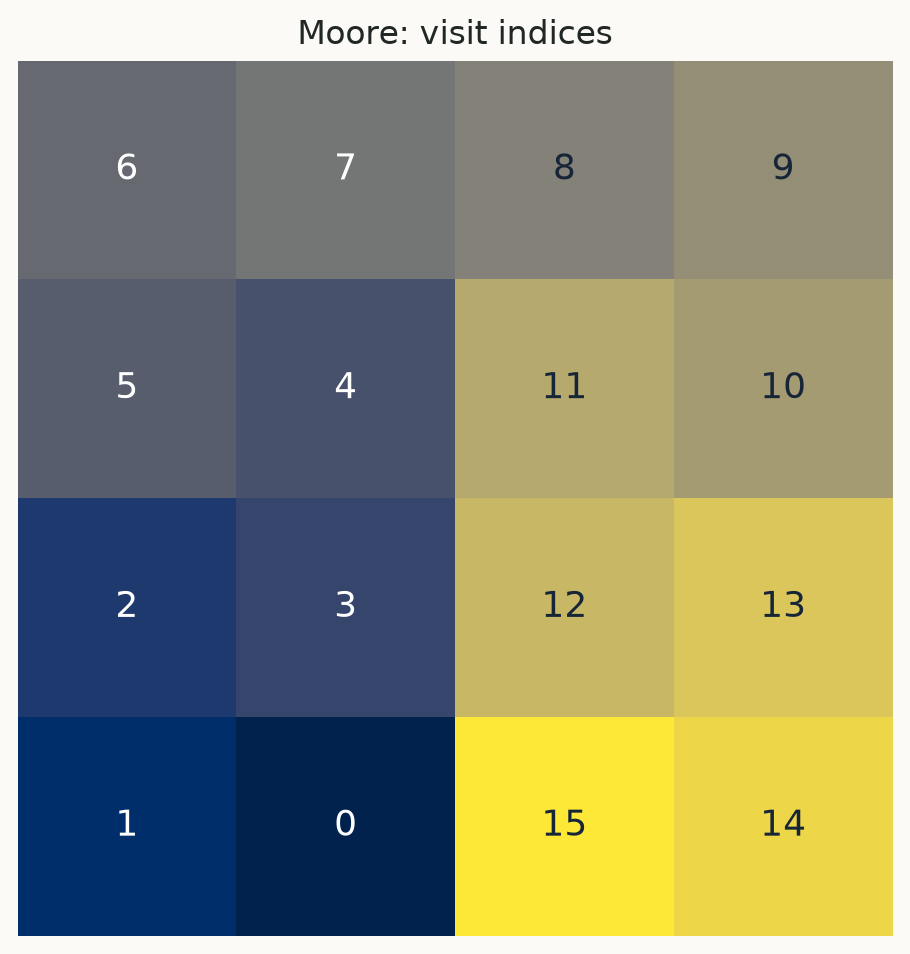
hp.curves.difference_map() compares these labels at spatially neighbouring cells.
Its definition is in the transform guide.
Direct indexing
index = 10**18
xy = hp.curves.index_to_xy(index, order=40, curve=12)
recovered = hp.curves.xy_to_index(*xy, order=40, curve=12)
assert recovered == index
These routines follow the recursive construction in \(O(k)\) work for order \(k\), without
materializing \(4^k\) cells. Python integers keep the result exact. Coordinates must lie
in [0, 2**order); sequence indices in [0, 4**order). This direct indexing currently
supports power-of-two squares only. Use grid() for other supported path sizes.
Compare paths up to square symmetry
key = hp.curves.canonical_form(points)
assert isinstance(key, bytes)
assert key == hp.curves.canonical_form(points[::-1])
The byte key ignores square rotations/reflections, translation to the origin, and traversal reversal. It is an in-process comparison tool, not a portable on-disk identifier: it uses the array’s dtype and byte representation. Use compatible integer arrays when comparing.