Build · Architecture
classic_esn
The standard Echo State Network baseline. Choose whether its readout uses the reservoir states alone or also sees the current feedback input.
Wiring
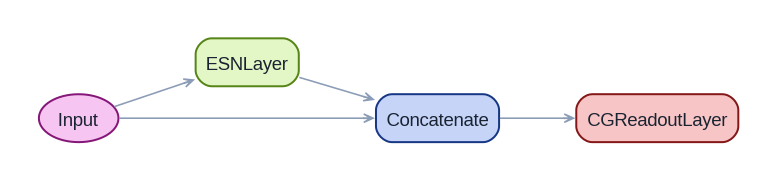
Input → Reservoir → Concatenate(Input, States) → Readout
This is the default, input_to_readout=True. With input_to_readout=False,
the wiring is Input → Reservoir → Readout and the head has
reservoir_size features. Both choices use the same reservoir initialization
for a given seed. Which predicts better depends on the data and other settings;
the automatic tuning workflow tries both.
The feedback signal drives a tanh reservoir, then rejoins its own states at
the concatenation, so the readout (a
RidgeReadoutLayer) solves ridge regression over
feedback_size + reservoir_size features. The linear part of the
input–output map reaches the readout unfiltered; the reservoir only has to
supply what linearity cannot.
Use
import torch
from resdag.models import classic_esn
from resdag.training import ESNTrainer

t = torch.arange(1401) * 0.05
series = torch.stack((t.sin(), t.cos(), (2 * t).sin()), dim=-1).unsqueeze(0)

model = classic_esn(reservoir_size=300, feedback_size=3, output_size=3, seed=7)
ESNTrainer(model).fit(
    warmup_inputs=(series[:, :200],),
    train_inputs=(series[:, 200:1200],),
    targets={"output": series[:, 201:1201]},              # next-step targets
)
model.eval()
preds = model.forecast(series[:, 1001:1201], horizon=200)  # (1, 200, 3)
truth = series[:, 1201:1401]                             # held-out continuation
Parameters
| Parameter | Default | Notes |
|---|---|---|
reservoir_size, feedback_size, output_size |
required | units, input dim, output dim |
topology, feedback_initializer |
None |
any initialization spec |
spectral_radius |
0.9 |
the factory scales; the bare ESNLayer defaults to None |
leak_rate |
1.0 |
1.0 = no leak |
activation |
"tanh" |
also "relu", "sigmoid", "identity" |
bias, trainable |
True, False |
random bias on; frozen reservoir |
input_to_readout |
True |
include the current feedback input in the head; False uses states alone. Exogenous drivers are never appended. |
readout_alpha, readout_bias, readout_name |
1e-6, True, "output" |
ridge strength; readout_name keys the targets dict |
readout, readout_kwargs |
"ridge", None |
direct Cholesky ridge by default; other solver names and options are supported |
**reservoir_kwargs |
— | forwarded to ESNLayer (e.g. bias_scaling) |
Choosing a baseline
Use classic_esn as the baseline against which augmented variants are
compared. For chaotic attractor reconstruction, start from
ott_esn instead.
Reference
H. Jaeger, The "echo state" approach to analysing and training recurrent neural networks, GMD Report 148, German National Research Center for Information Technology (2001).
See also
- ott_esn — the same skeleton plus state augmentation.
- Initialization — every
topology=and initializer spec this factory accepts. - Train — what
ESNTrainer.fitdoes with the warmup/train split.