Advanced
Raw HPO runner
Use this lower-level runner when you want to prepare every training and
forecast tensor yourself and build raw ESNModel graphs. The usual
model.tune(...) workflow handles chronological
validation, preprocessing, named ports and installing a fitted winner.
run_hpo returns an Optuna study and leaves winner reconstruction to you.
Its worker and scoring protocols are separate from the common tuner.
Parameters to explore
Useful search dimensions include:
| Parameter | Controls | Range | First move |
|---|---|---|---|
reservoir_size |
model capacity | 100–2000 | double it until gains stall |
spectral_radius |
memory horizon, stability | 0.8–1.2 | sweep ±0.1 around 0.9 |
leak_rate |
state update timescale | 0.05–1.0 | lower it for slow signals |
bias_scaling |
diversity of unit operating points | 0.0–2.0 | leave at 1.0; 0.0 recovers a zero-bias reservoir |
topology |
recurrent connectivity structure | registry names | default (dense random) first, graphs after |
feedback_initializer |
how the signal enters | registry names | default first; scale before structure |
alpha |
readout ridge regularization | 1e-8–1e-2 | step by ×100 on a log scale |
| warmup length | state synchronization | 100–500 steps | raise it until forecasts stop changing |
Spectral radius scales the recurrent matrix so its largest eigenvalue
magnitude hits the target, which sets how long an input echoes through
the state. Small values forget fast and stay stable; values near one
remember longer and produce richer transients at the edge of instability
— for driven, leaky reservoirs the best value often sits slightly above
1.0. Factories default to 0.9; a bare ESNLayer leaves the matrix unscaled
unless you pass a value.
Leak rate blends the previous state into the new one:
\(x_t = (1-a)\,x_{t-1} + a\,\tilde{x}_t\). At 1.0 the state is fully
replaced each step (the standard ESN); smaller values integrate slowly,
matching the reservoir's timescale to the signal's. Slow, smooth signals
call for small leak rates; leak_rate=0.1 with a spectral radius near
1.0 is a standard configuration for long-period oscillations.
Alpha sets the bias–variance tradeoff of a ridge readout such as
CGReadoutLayer. Too small, and the readout amplifies state noise and
forecasts diverge within a few steps; too large, and predictions
over-smooth toward the mean. The optimum shifts with reservoir size and
training length, which is why it belongs in every search space.
Searching with run_hpo
Three callables define a study: a model factory, a search space, and a data loader. Each trial builds a fresh model, fits the readout, forecasts over the validation window, and scores it.
import resdag as rd
from resdag.hpo import run_hpo

data = ...                                  # (1, 2300, 3) — (batch, time, features)
warmup, train, target, f_warmup, val = rd.utils.prepare_esn_data(
    data, warmup_steps=200, train_steps=1600, val_steps=300
)

def model_creator(reservoir_size, spectral_radius, leak_rate, alpha, seed=None):
    """One fresh model per trial. Must accept every key of search_space."""
    return rd.classic_esn(
        reservoir_size=reservoir_size, feedback_size=3, output_size=3,
        spectral_radius=spectral_radius, leak_rate=leak_rate,
        readout_alpha=alpha, seed=seed,
    )

def search_space(trial):
    return {
        "reservoir_size": trial.suggest_int("reservoir_size", 100, 500, step=100),
        "spectral_radius": trial.suggest_float("spectral_radius", 0.5, 1.2),
        "leak_rate": trial.suggest_float("leak_rate", 0.2, 1.0),
        "alpha": trial.suggest_float("alpha", 1e-8, 1e-2, log=True),
    }

def data_loader(trial):
    """Must include these five keys, each (batch, time, features)."""
    return {"warmup": warmup, "train": train, "target": target,
            "f_warmup": f_warmup, "val": val}

study = run_hpo(
    model_creator=model_creator,
    search_space=search_space,
    data_loader=data_loader,
    n_trials=100,
    loss="efh",
    seed=42,
    storage="study.log",                    # journal file: resumable
)
print(study.best_params)
The data contract is validated per trial: the dict must contain
"warmup", "train", "target", "f_warmup", "val", all 3-D
tensors. The forecast horizon defaults to val.shape[1]. Input-driven
models add drivers_keys=["driver"] and supply warmup_driver,
train_driver, f_warmup_driver, and forecast_driver entries — the
last one sliced with the pinned alignment.
Invalid trials and debugging
catch_exceptions=True continues after an invalid evaluation, but the
default error_policy="fail" records it as an Optuna FAIL trial so it
cannot win. Details remain in the trial's "error" attribute. A study
with no valid completed evaluation raises clearly. Pass
catch_exceptions=False to see the original exception immediately.
The explicit error_policy="penalty" retains legacy numeric penalties;
it still cannot return an invalid best model. Low-level TrialRunner
and build_objective keep their old penalty default for compatibility.
The actual forwarded model seed is recorded as trial.user_attrs["model_seed"]
when the creator accepts a seed; "trial_seed" records the trial RNG seed.
Use that model seed when reconstructing the winner. Forecast evaluation uses
temporary evaluation mode, restoring each module's earlier training flag.
transfer_from reuses evaluated scores and requires matching objective
directions. Only use it for the same data, scaling and objective. For a new
experiment, pass prior configurations through warm_start to evaluate them
again.
Losses
| Key | Behavior |
|---|---|
"efh" |
Expected forecast horizon — soft survival sum (default, chaotic systems) |
"forecast_horizon" |
Hard count of contiguous below-threshold steps |
"lyapunov" |
Error weighted by \(e^{-t/\tau}\) with lyapunov_t |
"standard" |
Mean geometric-mean error — stable or periodic signals |
"soft_horizon" |
Hill-gated survival horizon — smoother search landscape |
"attractor_dimension" |
Correlation-dimension mismatch for long-term attractor fidelity |
All are minimized; the horizon losses are negated internally, so lower
study values mean longer usable forecasts. loss_params passes kwargs
(thresholds, metrics) to the chosen loss; monitor_losses=["standard"]
logs extra metrics on every trial without optimizing on them.
With torch_scoring=True (the default), the five horizon/error losses score
directly on the forecast device; each checkpoint transfers only its final
scalar. The attractor-dimension loss uses NumPy. Custom losses can accept torch
tensors for the same device-local path, or use the automatic NumPy fallback.
Checkpoint pruning currently happens after the full trajectory is generated,
so it saves remaining scoring work, rather than forecast generation.
Multi-worker studies
Workers are separate OS processes coordinating through the storage file.
Journal storage ("study.log") is append-only and handles concurrent
writers; a .db path uses SQLite with WAL mode. BLAS threads are
throttled to one per worker before forking, and re-running with the same
storage and study name resumes where the study stopped.
Seed semantics differ by mode. Single-worker runs are fully
reproducible when the model creator accepts and forwards seed, as above:
seed seeds the sampler, and each trial reseeds torch/numpy/Python with
seed + trial.number. Multi-worker runs derive a
sampler seed per worker (seed + i·7919), but trial numbers are claimed
in arrival order — so per-trial seeds, and hence the exact trial
sequence, vary run to run even with a fixed seed.
An explicit sampler= is preserved in each worker with an independent copy
and a call to its reseed_rng() hook. Custom samplers must be picklable for
CUDA/spawn studies; their RNG policy determines reproducibility.
Reading a study
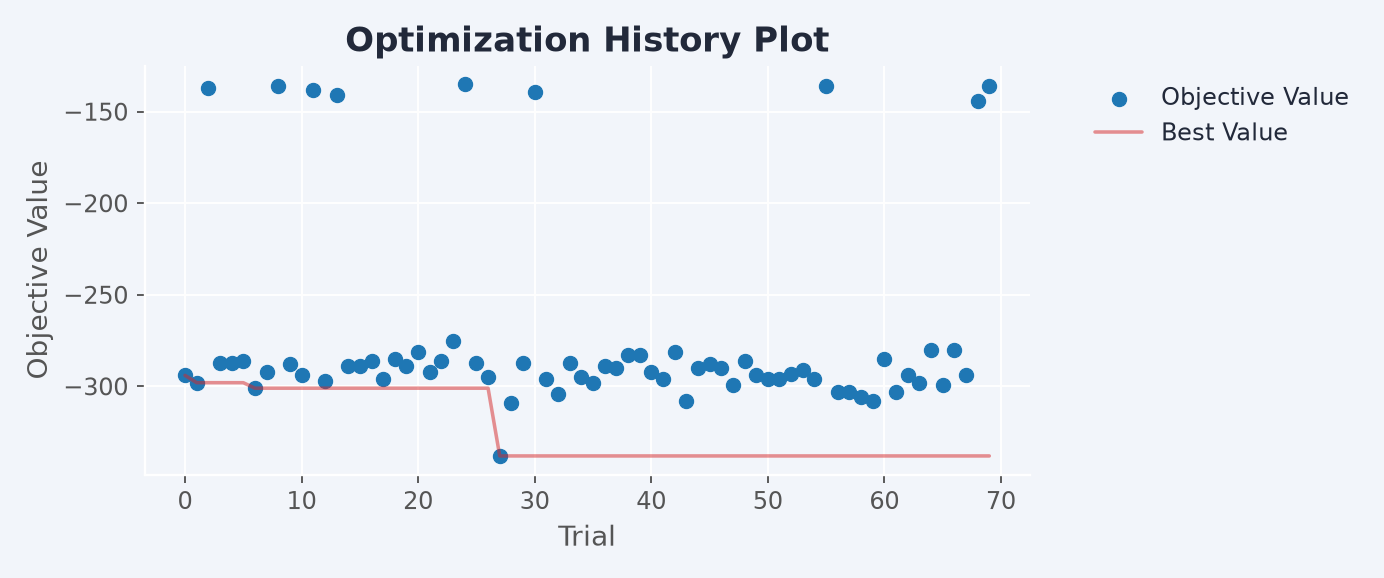
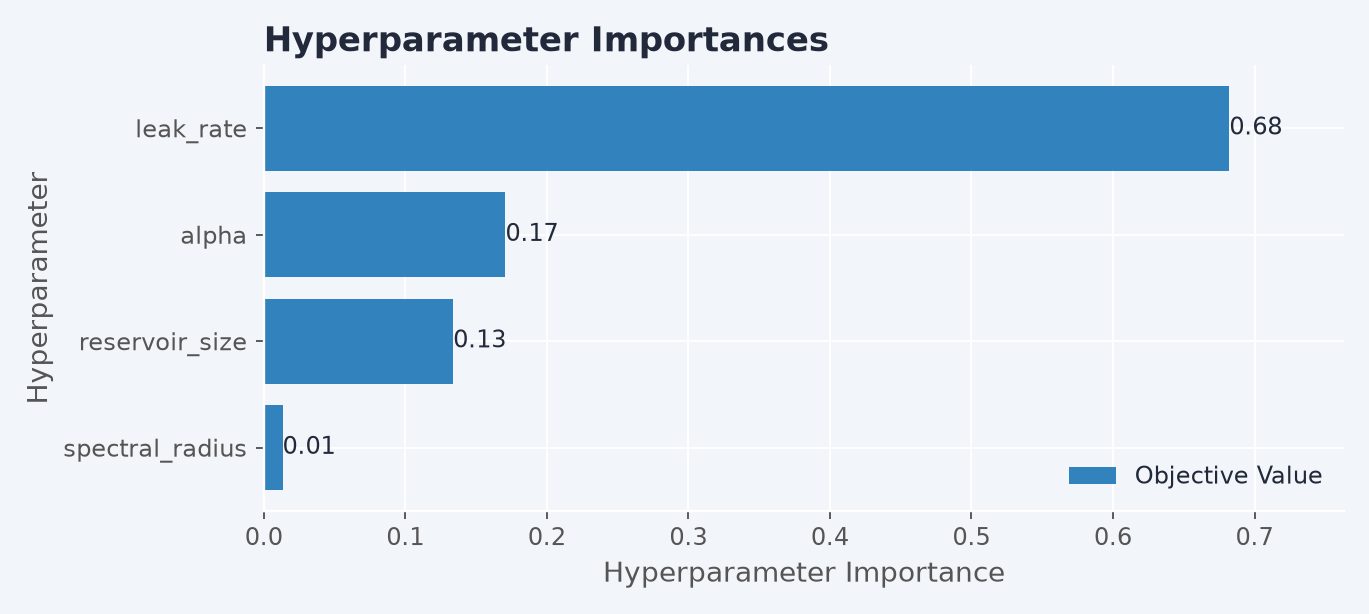
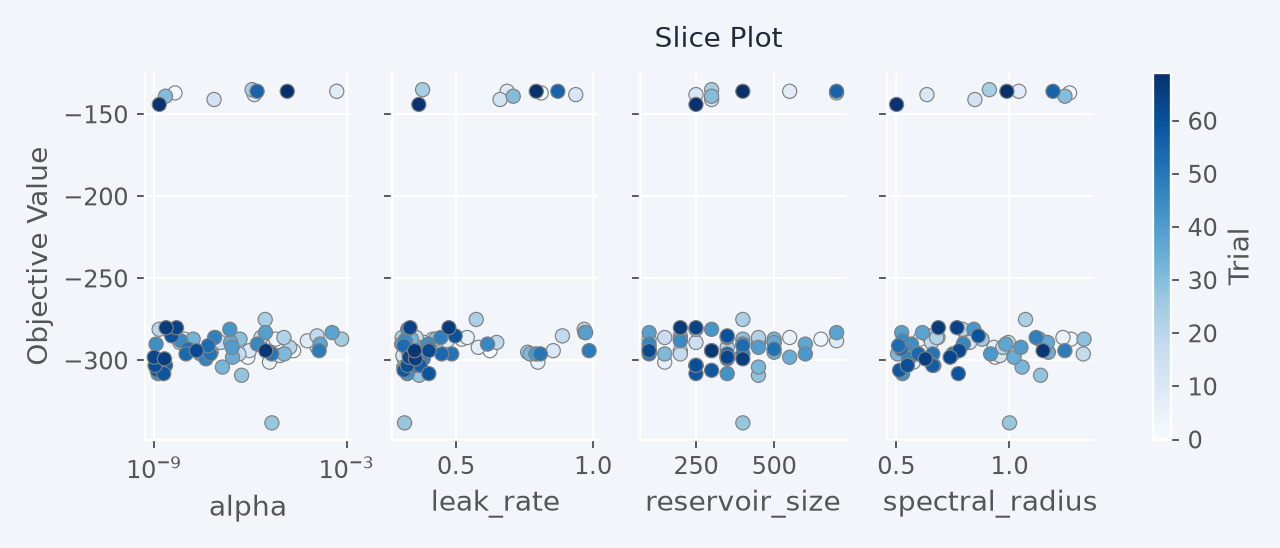
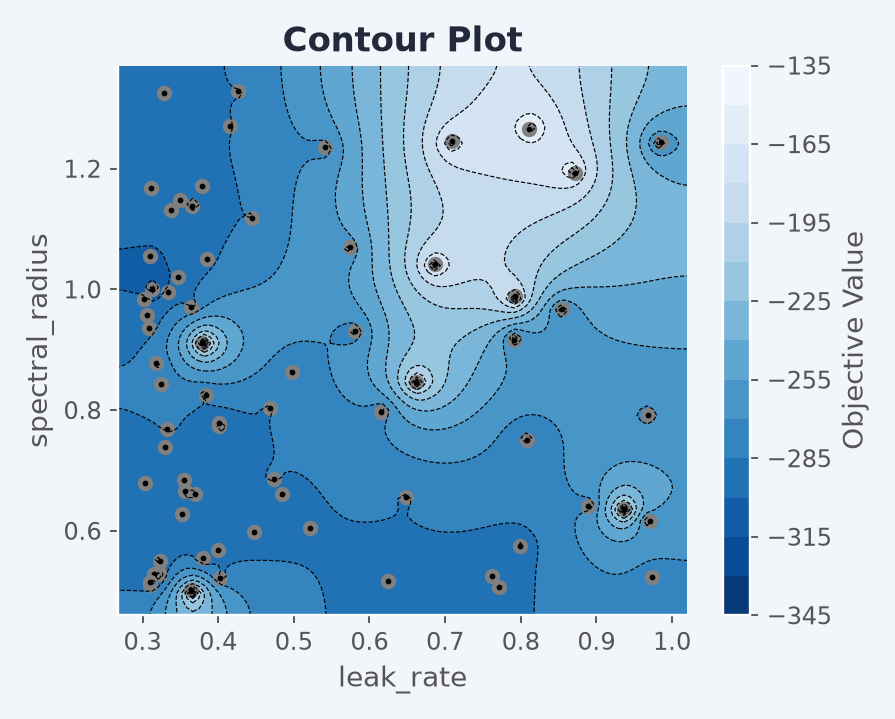
run_hpo returns a plain optuna study, so optuna's visualization module
works on it directly: optuna.visualization for interactive plotly
figures, optuna.visualization.matplotlib for static ones like the four
below, drawn from a 70-trial study maximizing valid horizon on Lorenz.
from optuna.visualization import plot_optimization_history   # plotly, interactive
from optuna.visualization.matplotlib import plot_contour     # static

plot_optimization_history(study)
Next
- Common tuning workflow — tune a preset or custom
Model - Scale & deploy — run the best configuration at scale
- Reference · HPO — every
run_hpoparameter