Build · Layers
NGReservoir
NGReservoir implements the next-generation reservoir computing family
(Gauthier et al. 2021): a reservoir with designed rather than random
dynamics. It has no recurrent weights and no randomness. Features are
built from time-delayed inputs and their polynomial products, so two
constructions with the same k, s, p produce identical features.
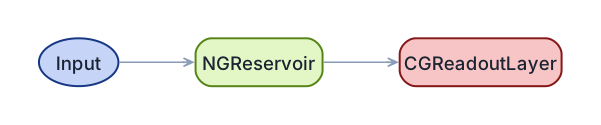
from resdag import NGReservoir

layer = NGReservoir(
    input_dim=3,            # dimensionality of each input vector
    k=2,                    # delay taps, including the current input
    s=1,                    # spacing between taps, in timesteps
    p=2,                    # polynomial degree of the monomials
    include_constant=True,  # prepend a constant 1.0 feature
    include_linear=True,    # keep the delay-embedded inputs themselves
)

features = layer(x)         # x: (batch, time, 3) -> (batch, time, 28)
layer.feature_dim           # 28
layer.warmup_length         # (k-1)*s = 1
What k, s, p control
k taps spaced s steps apart give the layer a memory window of
(k-1)*s + 1 timesteps; p sets the degree of the monomials formed from
everything in that window. With \(D = \text{input\_dim} \cdot k\) linear
features, the output dimension is
The three terms are the constant 1, the delay-embedded inputs, and every
monomial of exactly degree p; include_constant and include_linear
toggle the first two.
Exact degree, not degree-up-to-p (default)
By default the nonlinear block holds monomials of exactly degree p —
lower-order cross terms (degrees 2, …, p-1) are excluded. So
NGReservoir(p=3, include_linear=True) emits constant + linear + cubic
with no quadratic terms. This matches Gauthier et al. (2021), whose
Lorenz63 and double-scroll bases each use a single polynomial degree. Many
NVAR / NG-RC implementations instead use the cumulative "degree up to p"
basis — see below.
Cumulative degree (cumulative=True)
Pass cumulative=True to emit every monomial of degree up to p (the full
polynomial basis), rather than only the top degree:
With D = input_dim · k linear features, the nonlinear block then spans degrees
2 … p when include_linear=True (degree-1 monomials are dropped — they would
duplicate the linear block), or 1 … p when include_linear=False:
The default (cumulative=False) is unchanged and stays bit-for-bit identical to
previous releases; reach for the cumulative basis when porting configs that
expect "degree up to p".
Degree 1 (p=1)
With p=1 the degree-1 monomials are the linear features themselves.
To avoid two identical blocks (which would make the readout design
matrix rank-deficient), the monomial block is dropped when p=1 and
include_linear=True. With p=1 and include_linear=False the
degree-1 monomials are kept, since they are then the only
delay-embedded features.
Combinatorial growth
The binomial term grows fast in k, p, and input_dim; the layer
warns when feature_dim exceeds 10,000. If the warning fires,
reduce k, p, or the input dimension before training.
State and warmup
The state is not a hidden vector but a FIFO delay buffer of shape
(batch, (k-1)*s, input_dim). The standard state API applies, with
set_state validating that 3-D layout. The buffer needs (k-1)*s steps
to fill, and outputs before that contain zeros from empty slots: discard
the first warmup_length steps when accuracy matters. The full warmup is
those (k-1)*s steps, compared to the hundreds an echo-state reservoir
typically needs to wash out its initial condition.
When to prefer it
This family suits short datasets, where the (k-1)*s-step warmup
consumes little data; systems that are low-dimensional with smooth
polynomial structure; and settings that require exact reproducibility,
since the construction is deterministic and needs no seed. The
hyperparameters are three small integers that can be grid-searched
exhaustively, with no spectral radius, leak rate, or topology to tune.
The trade-off is the formula above: feature_dim grows combinatorially
with input_dim, so high-dimensional signals favor reservoirs that
compress into a fixed-size state. The layer has no learnable parameters,
and gradients flow through it to upstream modules.
See also
- Architectures — slotting a reservoir into a DAG
- Reservoir design — choosing between families
- Layers reference — full signatures